What would be 5 reference tools that our library should have for staff and students?
Earlier this year I went through our reference section and discarded several old, graffiti covered student dictionaries. I removed duplicate copies of outdated science books, and resources with significantly damaged covers. In reference to MUSTIE from CREW: A Weeding Manual for Modern Libraries, I actually removed mouldy, water damaged books. All of the materials were old enough that the spine labels had faded and were unreadable, so I printed new ones and inspected each book more closely. The newest book in the reference section is from 2017, a student dictionary, and the rest are from 2000-2016. It is safe to say that it is time to bring our school reference section to the 21st Century.
What are the 5 reference tools that my school library learning commons should have for staff and students? The first four are standard resources…
1. Encyclopedias
2. Atlases
3. Dictionaries
4. Thesauri
As for the 5th tool? Handbooks, manuals, directories, almanacs, and biographies are among some of the valid suggestions for important reference books.
1. Encyclopedias
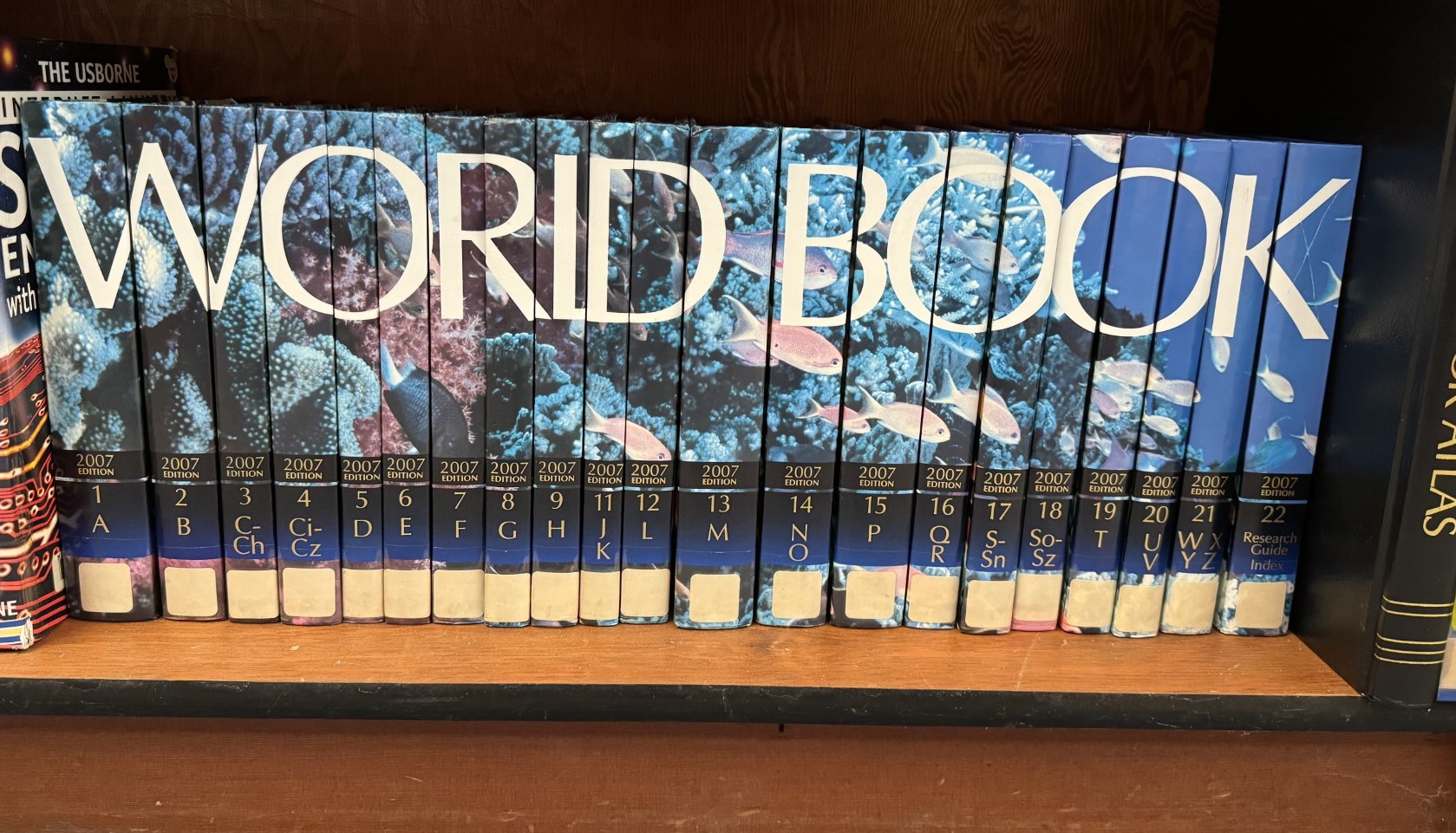
Our World Book Encyclopedia set is from 2007, a far cry from being current, but I am not going to spend our entire budget on a new print set. We do have access to current World Book Encyclopedias in a digital form. Recently, I set up a computer for students to access the library catalogue. I have shown students in grades 4-7 how to access the Digital Focused Resources, including the World Book Encyclopedia editions. I made a sign with instructions on how to access the digital resources and put it next to the computer as a reminder to students. We have a subscription to World Book Early Learning (K-Gr. 2), World Book Kids (Gr. 3-6), World Book Students (Gr. 5-9), World Book Advanced (Gr. 6-9), and World Book Discover (Gr. 5-9, leveled text).
On the KnowBC site there are several reference books, including two of my favourite books, which we also have in print in our library. The Encyclopedia of British Columbia by Daniel Francis, and Marine Life of the Pacific Northwest by By Andy Lamb and Bernard P. Hanby. Another reference book that looks really interesting is The Encyclopedia of Raincoast Placenames by Andrew Scott.
The Smithsonian and Britannica both have 2023 published general encyclopedias that are really great. They would make a great addition to the library reference section as well. They both use large, well organized images, with age appropriate text on a variety of curricular related topics.
2. Atlases
We have several world atlases but they are all outdated. I have been sourcing atlases but have yet to find a hard cover bound one that is age appropriate, current, and affordable. I looked online but it is difficult to tell if the book is suitable until I physically see it. I have been to several book stores however their collections are limited. There have been some great soft cover ones which I will likely purchase but I've seen nothing of the ‘coffee table’ style books that we would expect in a library. I will keep looking. In the meantime, I set out all of our atlases on display. It has been getting a lot of attention and use.
3. Dictionaries
We have an assortment of new looking dictionaries that have been meeting the needs of students. What we were lacking were picture dictionaries in other languages. We have many new students from other countries that are learning English. I also have had students request books on ‘how to learn another language.’ I am so excited to add a new plethora of picture dictionaries. We now have French, German, Japanese, Arabic, Mandarin, Vietnamese, Ukrainian, English, Spanish, and Thai. Each of the books has online audio that can be accessed from a device in the Collins Dictionary On the Collins site, there is also a quizlet link and games specified to learning the language of each of the books.
February 21 is Speak Your Mother Tongue Day. I am setting up a display featuring all our books that feature languages: dual language picture books, picture dictionaries, sign language books, books in braille, and books with Indigenous languages… I am looking forward to it.
4. Thesauri
We have a student thesaurus in good condition and a college edition which is not as user friendly but could be helpful to teachers or older intermediate students. There is also an online Merriam Webster thesauri, and the Collins Thesaurus has many options as well. Just the other day, while I was in Kidsbooks, I saw Absurd Words by Tara Lazar. It is another great book added to my 'consideration list' for our library. It would be a fun addition to our reference section.
5. Yearbooks, and almanacs
There are many options to choose from but because yearbooks and almanacs are popular among our students, I have decided that I will put the current, new yearbooks, and almanacs in the reference section until the next one is published the following year. Once the new edition is processed in the library, the previous year book can be moved to the shelf for circulation. For example this year’s Guinness Book World Records 2024, Scholastic World Records 2024, and the Sports Illustrated Almanac 2024 can be shelved or on display in the reference section. It should draw attention to the reference section and create some social opportunities for students to share the books in the library.
The general non-fiction reference material that is shelved for circulation gets well used. In her blog, Renovated Learning, Diana Rendina dismantled her reference section and shelved the books. She has seen an increase in use. I am not going to do this with all the reference books but will likely move some books over that are older, and would be of interest to students and teachers. For example there are a few space, and earth science books that could be better utilized if they were circulated.
The reference section in the library has been under-utilized so far this year. Sections that I have promoted have gone up in use, which shows that my role in connecting students to these resources is important. In the Resource Based Learning Slideshare, from Partito State University, they use the term ‘creating a learning culture.’ It is a great way to view my role as a teacher-librarian.
The National Archives of Boston reminds us of the Guidelines to a Successful Reference Interview. The five main areas to the reference interview are 1. Approachability, 2. Interest, 3. Listening/Inquiring, 4. Searching, and 5. Follow Up. I am making an effort to follow the guidelines, especially in following up with students and teachers to see if the resources have met their needs.
In the meantime, “It is teacher librarians’ responsibility to use whatever constitutes their collection as effectively as possible.” (Richard Beaudry, UBC 467 Course, 2024). I have lots of resources to work with (even if they are outdated) and look forward to continuing to build a 'culture of learning' in our Library Learning Commons.
Works Cited
American Library Association. National Archives of Boston. Guidelines of the Successful Reference Interview. Accessed February 18, 2024.
Beaudry, Richard. University of British Columbia. Course 467 Information Services, 2024.
Partido State University. Resource Based Learning, December 13, 2012.
Rendina, Diana. Renovated Learning, Three Reasons to Rethink Your Reference Section, February 14, 2014.
Wright, Steven. (Brainy Quotes.ca), "I was reading the dictionary. I thought it was a poem about everything." Accessed February 18, 2024.
“We live in a wonderful world that is full of beauty, charm and adventure. There is no end to the adventures we can have if only we seek them with our eyes open.”
– Jawaharial Nehru
A significant resource that needs exploration and purchasing at our school is non-fiction informational books about countries. There are four classes that require their students to use an inquiry process to learn about a country of their choice. "Teachers who use the inquiry-based approach view every learning opportunity as a place for student engagement in inquiry."(BCTLA,2022). The process of selecting a country, unpacking the requirements of the report, collecting information, assessing the information, writing, editing and presenting takes about four months.
Assessing the accuracy of information is an important and timely process for students. “Today’s students learn in a dynamic world where information changes and expands as fast as technological innovation. Information that grows exponentially and comes in multiple formats is presented without prior expert editing for truth or reliability, often without logical organization and frequently with a very short ‘shelf life.’” (BCTLA, 2022). Embedding the assessment of resources into the inquiry process is new for many grade 6 students. It can be an added frustration for students to discover that their online or print source is inaccurate, outdated, or irrelevant. During the inquiry process, students have found the need to check multiple sources for current data on population, or accurate names of specific government leaders. In our ever changing global climate having current print resources is a helpful starting point in inquiry.
The grade 6 teachers developed the Country Assignment as a Language Arts Inquiry Assignment. Students are required to write in a persuasive tone so that readers would like to visit their country of choice while providing information about population, culture, sports, wildlife, geographic features, climate, and destination sites. One of the Grade 6 Language Arts Big Ideas is, “Exploring stories and other texts helps us understand ourselves and make connections to others and to the world.” (BC Ministry of Education, 2022). Students need to use multiple print and digital sources for information. They are required to make a full sized tri-fold display board showcasing their report, images, and bibliography. They will also be presenting orally to parents and peers.
One of the relevant Grade 6 Communication Core Competencies from Building Student Success is Acquiring and Presenting Information, "Students communicate by receiving and presenting information. They inquire into topics of interest and topics related to their studies. They acquire information from a variety of sources, including people, print materials, and media; this may involve listening, viewing, or reading, and requires understanding of how to interpret information. They present information for many purposes and audiences, and their presentations often feature media and technology."
It is required that students use at least two print resources from which to gather notes. Our library has a selection of books about a variety of countries but they are outdated. There is also a disproportionate number of books on a few countries. For example, in our library there are many titles on France, but none on Brazil, Australia, New Zealand, or Ireland, all of which were chosen for reports this year.
Last year a number of books about countries were purchased from the Blastoff! Exploring Countries series. This is the publication that was also recommended by other teacher-librarians. In general, the books are suitable but were published between 2010 and 2015. At approximately $25 a book, it seems like a lot of money to spend on an outdated source. After searching the public library resources with students, we found that the most suitable books were travel guides. They were the most current, informative print books available. I met with teachers giving the assignment and suggested that I look into purchasing some travel guide books for the library. They agreed that building a collection of ‘country’ guide books would be helpful to students. While allowing the students to choose their country gives them creative freedom, it also creates a challenge. There are currently 195 recognized countries in the world. It is unrealistic to have a book on every country before students choose. There are some general trends over the years for country choice, and some obvious gaps from this year. It is these gaps that I am exploring resources for to fill the immediate need.
Using the 'selection criteria for reference material' in Achieving Information Literacy: Standards for School Library Programs in Canada (Asselin, 2006), Reference Skills for the School Librarian (Reidling, 2019), and from Focused Education (Focused Ed, 2022), I designed a rubric to help evaluate reference resources and its usefulness in our school program. I tried to make the rubric comprehensive but flexible enough to be used to evaluate any resource material.
After looking through travel guides at both the library and book stores, I concluded that the most suitable books for our school needs were the DK Eyewitness books, and Insight Guides. Both of these resources were recently updated, had a larger font for ease of reading, many large images, detailed maps, in-depth information on history and culture as well as access to online material. The Lonely Planet books had fewer images, and dedicated large sections of the books to specific costs of accommodation and food.
The DK Eyewitness books range in price from $ 27. 33- $35. 99 CA at Indigo Books which had the best prices and widest selection of Countries. Depending on the country, the newest edition of books were published in 2022, or 2023. Over 40 different country Guide books are available, not including features on major cities, which have their own guide book. Indigo offers a school discount. Ordering from DK directly converted prices into pounds and required shipping from the United Kingdom adding significantly to the cost. I completed the Selection Criteria Rubric using the DK Eyewitness Australia book.
The country books that have been requested for priority this year are Australia, New Zealand, Ireland, Brazil, and Norway. To purchase guide books for 5 countries is: $114.25, and minus the school discount of $17.14, totals $97.25 plus tax, is $104.06. With a collection plan in mind, each year the school library budget could set aside approximately $100 each year to continue building the country travel guide resources in the library.
The DK Eyewitness books contain the information needed by students to contribute to their reports. The travel guides have a table of contents, an index, and colour coded chapters to different parts of the featured country. The books have detailed maps, graphics, and beautiful photography making them more visual than other guide books. The guide books recommend online sites to provide more information about specific features in the books. In particular, it listed an authentic Indigenous website to direct readers to learn more about Australia's Indigenous Peoples. I feel the DK Eyewitness books would be a suitable print resource for students to use in combination with online sources to collect information for their reports.
In addition to the travel guides, two other resources that are suitable and will added to the library collection are The Lonely Planet Kids: The Travel Book (Lonely Planet, 2022) for $27. 91, and The Lonely Planet Kids: Amazing World Atlas (By Alexa Ward, 2020) for $27.56. Both books are visual, with useful information and designed with appeal to all ages. There is a limited amount of information on each country but both books provide an excellent starting point for further inquiry.
As I become more experienced in assessing resource materials, I suspect I will simplify the Selection Criteria rubric to make the form more streamlined, and allowing space to assess a few resources on one rubric. It has become apparent to me through this assignment that I really need to browse the print copy of the book myself, rather than rely on reviews. In knowing my students, I can already guess which ones are going to be excited when these resources are ready for circulation.
References and Works Cited
Asselin, M., et al. Achieving Information Literacy: Standards for School Library Programs in Canada. The Canadian School Library Association, 2006.
British Columbia, Ministry of Education (n.d.). Core competencies. Victoria, BC: Ministry of Education. https://curriculum.gov.bc.ca/competencies
Dorling, Kindersley, DK Eyewitness Australia, London, United Kingdom, 2022.
Ekdahl, M., M. Farquharson, J. Robinson, L. Turner. (2022). The Points of Inquiry: A Framework for In- formation Literacy and the 21st Century Learner.: Revised ed. Vancouver, BC: British Columbia Teacher-Librarians’ Association. (Original Work published 2010)
"Who needs a librarian and cataloger when you have Google and the internet? Well, who needs a teacher when you have Wikipedia? And, who needs a doctor when you have WebMD? Just as Wikipedia doesn't replace the teacher, and WebMD doesn’t replace the doctor, In the same way, Google search and internet doesn’t replace the librarian and cataloger."
-Salman Haider (b. 1977. Librarian, cataloger, blogger, and creator of Librarianship Studies & Information Technology blog)
With many school Library Learning Commons (LLCs) eliminating their print reference sections should I be doing the same? At this point, I think not. New to my current library, it has taken me a few months to learn the collection, and by learn, I mean ‘get introduced.’
Last month I weeded the reference section of damaged, outdated and irrelevant books. I discarded 48 books, of which 11 were old student dictionaries that were covered in graffiti and over 10 years old. I then organized the shelves by genre for the most part. In Reference Skills for the School Librarian: Tips and Tools is says, “A good reference source is one that serves to answer questions, and a bad reference source is one that fails to answer questions.” (p. 23, Reidling, Houston, 2019). If I combine this guideline with MUSTIE, it justifies my discarding even more books as I go through them.
Not one person has touched the encyclopedias since I started in the library, nor has anyone asked about them in any way.
In Reference Skills for the School Librarian; Tools and Tips, it states, “Some reference materials, obviously, become outdated. If so, a school librarian should consider the following basic guidelines: print encyclopedias should be replaced every five years (and the old ones not sent to a classroom, but discarded).” (p. 18, Riedling, Houston, 2019).
I have not packed up the encyclopedias because I am waiting to see if they are used at all, and I am sensitive in my situation as a temporary librarian. Having already made several changes and knowing that the ‘contracted’ librarian will be returning next year, I figure that I had better not act until I am sure it’s ok. I’ll give it some more time but will likely discard them at some point this year. I have noticed that book recycling centres do not accept encyclopedias so I anticipate that I’ll be taking them apart to recycle the paper and throw out the covers.
After the reference section was tidied up and labeled, it was easier to see and browse books with more space on the shelves. A group of primary students soon discovered the pop-up books and their library visits have been enriched ever since. The pop-up books create a nice social arena for students to talk and figure out how to ‘fold’ the books up again. Complex learners especially like the dynamic interaction with the books.
What about the rest of the reference section? Have other reference books been used? In the past month several of the intermediate classes have started research assignments and some students thought to see what reference books were on the shelf before searching the catalogue. There was really nothing there for them other than one student who looked at a book about Egypt for her passion project. The large ‘coffee table’ photographic books of Canada and British Columbia have been recently used by Grade 3 students learning about landforms. The historical atlas has been useful by the Grade 4 students learning about the Fur Trade. We had body science presentations a few weeks ago which sparked interest in the body books, many which have large fold out pages, too large for a student desk but perfect for a large library table.
That’s about it. Given that our library has about 600-800 student visits a week between scheduled and non-scheduled book exchanges…I would say the reference section is the least used section in the library.
For National Mathematics Day, I asked every student to colour a tree and we created a collaborative tessellation. Our reference section had a large coffee table book about MC Escher which I presented to students. It was the first reference book I used since starting in the library in three months earlier.
I figured the best way to promote the reference books was to make a current and relevant display. I set up a salmon display when our salmon eggs arrived in our library. The display included two reference books, one on salmon, the other on marine life in the Pacific Ocean. It worked! The books have been getting quite a bit of attention. Given that both books have large, glossy photos with little text, they generate a lot of questions from students. These books have become a valuable tool as a springboard for deeper inquiry.
How does the print reference section differ from the digital reference sources available? The print references are tactile, and aesthetic. The art books, body books, pop-up books are held in hands, peered upon, and read by several students at the same time. There are social interactions, and learning connections being made as students talk about what they see and read. The print resources lend themselves to inquiry based learning by appealing to students’ tactile, and visual senses. There are opportunities to learn unexpected things from unexpected places with no device necessary.
There are limitations in our print collection. Our library books about ‘countries around the word’ are lacking and outdated. I have discarded grossly outdated books but the selection was bare to start with. I have been looking for current books about the countries being researched and have found that the books are expensive and published 5-15 years ago. It does not seem prudent to spend so much money on outdated materials when ‘up to date’ digital resources are available for free. Intermediate students research ‘a passion project,’ which is a topic of their choice. The student interest changes yearly. Is it practical to have 2-3 books about ‘everything each student is passionate about?’ I have tried to fill the library gaps as best I can with a limited budget but it is just not realistic. I don’t have the funds that allow me to have current books on such a broad range of topics. If it is a ‘trendy’ interest I can justify buying some books on the topic knowing the it is relevant and will interest others as well.
Digital resources are current and the content is almost unlimited. Students can research anything they need to know about. Students will require a device, which may not always be available. Rapidly growing enrollment at our school means that our school iPads, laptops and lab computers are booked most of the time. For some things it is simply easier and faster to look it up in a book, like a dictionary, or thesaurus rather than hunting down an available device. When students use the computer lab, and laptops there is one student per computer and there is very little discussion between students unless it is for technical trouble shooting. There is some opportunity for interactions with iPads because sometimes the students share one, but all in all, using the digital resources is mostly solitary. When researching, our students are encouraged to use vetted sources available from Focused Resources Digital Resources, and sites like it. In Achieving Information Literacy by Asselin, Branch, and Oberg, it is suggested that 'acceptable' school library collections include over 25 digital titles, and at least one digital reference database including electronic an encyclopedia (p. 30, Asselin, Branch, and Oberg, 2006). Often students use general internet searches that exposes them to advertising and distracting links on the sidebar.
We must keep in mind that many parents have become vocal about their concerns about how much screen time their child is exposed to. I’ve learned that many parents like having the ‘allowable’ screen time to be at their discretion, and want their kids off screen at school unless it is for essential learning. We as educators need to teach digital literacy skills but this should be in conjunction with print literacy skills. Many of the tools and processes are similar.
In Reference Skills for the School Librarian: Tools and Tips it says, “For school librarians reference services are more than just information skills or activities; these services represent significant and meaningful engagement in a profoundly human activity, ministering to one of the most basic needs of humans-the desire to gain knowledge.” (p. 3, Riedling, Houston, 2019).
The reference section in our library does allow our students to gain knowledge, but it is going to need me promoting the books to draw them into the reference section. When I take down the salmon display, I thought I would display some of the art books with art supplies and blank bookmarks for students to design. I can also feature some of the pop-up books with instructions on how to make pop-ups. There are some great websites with kid friendly instructions.
I love the phrase, “Using technology to promote books—not replace them!" which is the first thing you see on Joyce Valenza’s slideshare, Reading 2.0. A few slides down there is a photo of an open copy of Twilight with a tag that lists several related websites. I think this is a great way to promote reference materials as well as fiction and non-fiction books. Her blog entries in Never Ending Search are insightful and cover a range of library issues and ideas.
I will also display some of the historical reference books with fiction and historical fiction books that relate to the same setting or timeframe. Creating trivia questions and setting up some relevant realia (related everyday items) to encourage interest and inquiry could also be successful.
When the reference books are used, do they answer the questions of the users? No, not really but they do provide an opportunity for a general ‘overview’ of a particular subject. The books also prompt discussions and questions. The reference books are still useful … for example, although the Egypt book used by a student for research was outdated, I could show the student to look at the chapter names and bold text headings to guide them in their online search. Photos from the reference book also gave them some direction for further inquiry. The Greek phrase for ‘encyclopedia’ translates as ‘general education.’ (p. 66, Reidling, Houston, 2019). In this way, the reference resources are meeting some needs.
I’ll disprove myself… I had Grade 7 students ask me for a dictionary the other day because they were playing Scrabble at recess (the library is open at recess and lunch three days a week). The best part was the squeal of joy when one student discovered ‘pog’ was in fact, a word. In Reference Skills for the School Librarian: Tools and Tips, it states, “…there still remains a distinct and important place for numerous versions of general, foreign language, historical, slang, and dialect, thesauri, and specialty dictionaries in today’s modern, technological school libraries.” (p. 64, Riedling, Houston, 2019)- absolutely! It is my job to show students how useful and easy these resources are to use but they must be present in the library in order for me to do this.
“A resource is any material, regardless of form or location, which provides necessary answer(s).” (p.3-4, Riedling, Houston 2019). The dictionary DID provide the grade 7s with the necessary answer so that reference book is staying for now.
In the meantime, I have started an analysis of our library collection by surveying students and teachers by asking for input on their library needs. I have run several Follett reports that show the make up of our library collection and I now feel like I can begin to start to work on policies for evaluation and selection. "It is better to have a small but relevant and up-to-date collection of materials than a large collection that is neither useful or of good quality." (p. 25, Reidling, Houston, 2019). To keep, or not to keep reference resources? I will be keeping what is relevant, and looking to update and replace other resources. The digital resources are accessible to students, so I will aim to keep print resources accessible to them as well.
"A person who never makes a mistake has never tried anything new." Sidewalk sign on Hastings St.
My journey to become a teacher of the 21st Century is well on its way. My vision of implementing a Maker Culture has been established and growing. My technological skills are developing every day. At first I challenged myself to learning a new digital tool each week and teaching it to a colleague or student. I do this much more often and can't believe that in a short time I have become a 'go to' person for trouble shooting tech at school.
My mindset has changed. I used to be so anxious about making a mistake that I wouldn't try. Now I start, and if I make a mistake I try something else and maybe eventually ask for help. Speaking of help... thank you all for your thoughtful suggestions and feedback. Your wealth of knowledge is humbling and I deeply appreciate your openness and generosity.
My digital artifact is a video that educates others on the value of Maker Culture in schools. The concept of my final artifact changed several times... It took me awhile to figure out that what I wanted to say, and needed to say were not the same. Speaking of help, again... I could not have pulled it off without help from a friend (who happens to be a former student), which is a really positive and impactful way to learn, mistakes included.
My plan for sharing this digital artifact is to first share it with staff at a 'lunch and learn,' then with the Parent Advisory Committee (PAC). With staff I will also be highlighting the STEAM Trolley (including assessment rubrics with the new reporting language that will be implemented next year) and inviting teachers to use it in their classrooms. As you may have read in my previous blog, our librarian and I have started a lunch time Maker Club with Grade 7 students taking on leadership roles.
With the PAC I will feature the STEAM Trolley and have a couple of students share about their favourite activities. I will be challenging the PAC members to support our school by investing their hard earned funds in tools and digital technologies that can be shared by the school. Building a Lego Wall in the library and purchasing a few sets of screw drivers (Breaker Space), Makey Makey, or micro bits are the first requests.
After several edits I decided that the video would be most useful to me if it was quite general. That way I can potentially share it with older students, but more importantly with my new staff, and PAC when I eventually get a job as a teacher-librarian. I would love to share some of the most popular activities at a school district workshop and the video might be suitable for that presentation as well, or I can make new one now that I know how.
I have never spent so much time on a single project before! I wish I had logged the specific time spent just on making the video. I am going to guess it took around 30 hours. Writing the script was the first task. I think it started as five pages then I edited down to three. I kept thinking to myself, 'Less is more!' At the same time, I was collecting and cropping classroom photos, and screen shots to use in Google Slides. It seemed like a good way to organize the presentation so I could visualize potential images as I read the script.
I absolutely needed help with recording my voice and all the video related technology. I had never done anything like this before. My friend borrowed a good quality microphone and we set up a little 'studio' in my bedroom closet. It took several tries to get the sound right. I needed to hang more blankets and lay down a yoga mat to get rid of the echoes. I think we recorded the script (or sections of it) fifteen times. I have a whole new appreciation for how much time and work goes into a five minute presentation. My friend used Audacity to split the audio into the right files and then helped me move it into Canva Video. I needed to watch several youtube tutorials on how to use Canva video. They were helpful in adding a level of professionalism to the final project. Most of editing process in Canva is 'drag and drop' so it was very beginner friendly. There was a plethora of stock images and videos to use. It was finicky to get the images and sound lined up as well as the general animation timing. I already had a google account so uploading the project to youtube was straightforward. I learned a great deal during the process and I am proud of my final project. I hope you enjoy it as well!
My digital resource.
My greatest take away from this learning journey is that as a future teacher-librarian I will need to be a digital mentor. I have a long way to go to catch up on skills, but I have already started and more importantly I have changed my mindset so that I am enjoying the process now (rather than being anxious). The technical skills I acquire(d) are gifts that I can use in my personal and professional work, as well as share with others.
I have also learned that there is lots of solid research supporting Maker Culture, and STEAM activities. Making always 'seemed right' for my students, but it felt like a reward or extra activity. Creating a maker culture is really embedded deeply in our current curriculum and school district vision and goals.
I have connected with great colleagues across the country. It is really refreshing to speak and write with teachers and teacher-librarians that are outside of my district and can offer a different perspective (or the same).
In the future I hope to get hired as a teacher-librarian where I can share my love of inquiry-based learning, literacy, social justice and Maker Culture. I will continue to grow as a learner myself so I can be a mentor and support person for my staff.
In preparation of reflecting on my rationale I went back and read over my first blog entry. I just noticed that I did not title it or put on any labels. I was a nervous wreck when I wrote it because I wasn't sure it was going to be 'good enough' compared to others who have been posting to blogs for years. It took me awhile to figure out how to upload photos.
As for the content, the key concepts have held true throughout my journey. Curiosity, creativity, collaboration, authentic assessment, risk taking, educational balance, inquiry, engagement, and digital technology have remained central throughout my research, writing, and action.
A significant challenge that has presented during this journey is equity. I work at a small school with a PAC that works hard to raise money, but doesn't come anywhere near other schools in more affluent areas. This is most evident in the lack of resources our school has in technology tools. I am hopeful that my video my help divert funds to our school library and STEAM initiatives.
Students testing wind turbine (photo release with permission)
Finally, I really tried my best to respect the privacy of my students when posting photos. I used mostly my own photos because it represented my journey best. I took lots of videos in my class but if I cut the students faces out of the frame it wasn't effective. I wanted to include a video of my students testing their wind turbines but I could not get permission for photo release for one of the students. In the end, I didn't use any videos although I would have loved to showcase the joy in my students' faces and voices.
It was really overwhelming to choose a topic for this learning journey but I am glad I chose Maker Spaces. Full STEAM ahead! I've got a Maker Culture to nurture and grow.
Works Cited & References
About Us. Empower the Learner. (2021, August 29). Retrieved November 6, 2022, from https://empowerthelearner.com/about/
BC Ministry of Education. (n.d.). Applied Design, skills and technologies. Building Student Success - B.C. Curriculum. Retrieved November 12, 2022, from https://curriculum.gov.bc.ca/curriculum/adst
Brown, J. (2017). Uncovering the truth about Maker Spaces. In Canadian School Libraries Research Archive.
Butler-Kisber, L. (2020). How do Makerspaces heighten student engagement? EdCanNetwork.
Cowen, A. (2022, November 4). 26 projects to jump-start your makerspace: Science buddies blog. Science Buddies. Retrieved November 20, 2022, from https://www.sciencebuddies.org/blog/makerspace-projects
Curriculum. (n.d.). Retrieved November 6, 2022, from https://curriculum.gov.bc.ca/
Davidson, A.-L., & Price, D. W. (2018). Does your school have the maker fever? an experiential learning approach to developing maker competencies. LEARNing Landscapes, 11(1), 103–120. https://doi.org/10.36510/learnland.v11i1.926
Fingal, J. (2022, October 27). How curiosity, creativity and Student Agency unlock student learning. ISTE. Retrieved November 6, 2022, from https://www.iste.org/explore/education-leadership/how-curiosity-creativity-and-student-agency-unlock-student-learning
Hunt, C. (2019, March 18). Tinkering with makerspaces. Canadian School Libraries Journal. Retrieved November 20, 2022, from http://journal.canadianschoollibraries.ca/tinkering-with-makerspaces/
Littlebins. (2020, July 31). Printable Lego challenges for kids. Little Bins for Little Hands. Retrieved November 20, 2022, from https://littlebinsforlittlehands.com/lego-challenge-calendar-ideas-kids/
Makerspaces: The Benefits. curiositycommons. (2016, April 25). Retrieved November 20, 2022, from https://curiositycommons.wordpress.com/makerspaces-the-benefits/
Nadelson, L. S. (2021). Makerspaces for rethinking teaching and learning in K–12 education: Introduction to research on makerspaces in K–12 education special issue. The Journal of Educational Research, 114(2), 105–107. https://doi.org/10.1080/00220671.2021.1914937
Otieo, C. (2017). Makerspaces: A Qualitative Look into Makerspaces as Innovative Learning Environment Catherine Otieno Follow this and additional works at: https://digscholarship.unco.edu/dissertations This Text. University of Northern Colorado Scholarship & Creative Works @ Digital UNC, 1–161.
pathway2success. (2022, February 2). Strategies to engage reluctant learners. The Pathway 2 Success. Retrieved November 20, 2022, from https://www.thepathway2success.com/strategies-to-engage-reluctant-learners/
Rouse, R., Krummeck, K., & Uribe, O. (2020, February). Making the most of a Makerspace. NSTA. Retrieved November 12, 2022, from https://www.nsta.org/science-and-children/science-and-children-february-2020/making-most-makerspace
Student Centered Education. Strategic plan 2021-2031 - north vancouver school district. (n.d.). Retrieved November 12, 2022, from https://www.sd44.ca/Board/StrategicPlan/Pages/default.aspx#/=
The benefits of Teaching Steam Lessons: Resilient educator. ResilientEducator.com. (2020, December 10). Retrieved November 20, 2022, from https://resilienteducator.com/classroom-resources/benefits-of-teaching-steam/
Vandenbroek, A. (2013, October). BEYOND BOOKS: BRINGING STUDENTS INTO THE LIBRARY THROUGH /J CREATIVE PROGRAMMING. Retrieved November 12, 2022.
Vongkulluksn, V. W., Matewos, A. M., Sinatra, G. M., & Marsh, J. A. (2018). Motivational factors in makerspaces: A mixed methods study of elementary school students’ situational interest, self-efficacy, and achievement emotions. International Journal of STEM Education, 5(1). https://doi.org/10.1186/s40594-018-0129-0
Ways to use Lego in the classroom. Teaching Ideas. (2019, September 18). Retrieved November 2
"Vision without action is merely a dream. Action without vision just passes the time. Vision with action can change the world."
Joel Barker
How do I create a 'maker culture' in my school without space or funds? Our school is under construction so our 'in between' spaces are currently storing building materials and we have no space for storing educational items. We are a needy school without funds to start new projects. How can I put my dream of having a 'maker space' at school into action?
I repurposed a rolling trolley that used to hold a projector. I purchased several inexpensive clear bins with lids and grabbed some old bigger bins from home. I put a call out to my staff for specific recyclables and I began my research.
Next, I collected relevant materials that I already had in my classroom or at school. I pulled out origami and paper airplane books, as well as all my STEAM and maker books. These could be incorporated into the maker bins for inspiration and instructions. I made notes, and found samples of some ideas of projects that I had done with previous classes and made a trip to the dollar store. My colleagues (at school and at UBC) generously shared some of their resources with me.
The more research I did, I realized that the purpose of the activities were quite different. Some of the activities were 'problem solving' tasks, others were 'creative' tasks. I changed the name of the Maker Cart to the STEAM Trolley as the activities were varied and covered all the disciplines: Science, Technology, Engineering, Art, and Math.
Developing curiosity, creativity, and collaboration are my key intentions for students using the STEAM Trolley.
I have shared the STEAM Trolley with my class several times since its conception. Students were highly engaged and worked with others while pursuing tasks. I overheard several students say, "This is hard!" but to my delight they stuck with their task and completed their projects. The open-ended nature of the activities lead students to laugh, instead of being upset when their plans didn't go as expected. It may have helped that I introduced my son's robotic team's motto, "Fail hard, fail often."
In Leading from the Library: Help Your School Community Thrive in the Digital Age, Miller and Bass suggest “When we give our students the opportunity to explore and create, we also improve our culture by offering new and exciting experiences.” (2019). A classroom maker trolley is a new and exciting experience for both my students and me. The bins can easily be swapped in and out, and by adding new ones to keep interest high.
In Beyond Books: Bringing Students Into the Library Through Creative Programming, Alicia Vandenbroek suggests, “As the role of the librarian continues to evolve, it is critical that we focus not only on books, but also on all the other resources we provide.” (2013). I incorporated several of Vandenbroek's most successful programs like origami, technical drawing, paper airplanes, and friendship bracelets.
Each bin contains everything needed for small groups of students to work, and many activities can be easily adapted for a whole class to use.
Two large bins that contain recyclables are for 'creative making.' In Tinkering With Makerspaces author Christopher Hunt says, "We try to go off book, and deviate from, or ignore, instructions. We try to throw away the cookie cutter (smash it, really). Each kid should be able to proudly say, “I made this; I’m impressed with my creativity; let me tell you how I did it; let me tell you about the things that went wrong; let me tell you how it works now, and what it is for….” With each of my students I kept challenging them to improve or adapt their projects to make it their own. I certainly had no problem with students sharing their creations. They were always quick to talk about what their project was and how they made it.
Pinterest
I have collaborated with my school librarian to start a lunch time Maker Club. We decided that the club would be for Grade 2 and 3 students because the Grades 4-7 students have lunch time opportunities such as choir and floor hockey. We already have grade seven students that have expressed interest in leading the club. We are going to start with some simple winter crafts, then after the holiday open up the STEAM Trolley to the Maker Club. We will also offer the Spheros during an after school session as there won't be enough time during lunch. The advantage to using the Spheros after school is that parents can view their child's work when they are picked up. Why is fostering a maker culture important? There is an overwhelming amount of research that supports developing a 'maker culture' in schools and public spaces like libraries. In The Resilient Educator the article The Benefits of Teaching STEAM Lessons the writers describe benefits such as meaningful collaboration, increasing critical thinking skills, hands on experience, non-linear problem solving, and encouraging different ways to value the arts.
With a broader educational goal in mind What is STEM and Why is it Important? article the author and researcher David White concludes that teachers of K-12 are important influences in introducing the STEM concepts and that, "These concepts may lead to the students pursuing a STEM major in higher education and ultimately choose a STEM career within the workforce."
In Makerspaces: The Benefits the article outlines advantages that are close to my heart. It references recent research that supports that makerspaces are learner-centered, empowering, and authentic. “When we allow children to experiment, take risks, and play with their own ideas, we give them permission to trust themselves. They begin to see themselves as learners who have good ideas and can transform their own ideas into reality.” The article also explains that maker spaces help prepare students for the future. "Makerspaces are increasingly being looked to as a method for engaging learners in creative, higher-order problem-solving through hands-on design, construction, and iteration.”
“Ultimately, the interdisciplinary and empowering natures of these makerspaces can help prepare youth for a future we can’t yet imagine.” Davee, Regalla & Chang, 2015
Another important benefit of maker spaces is the high level of student interest and engagement, especially for students that may be struggling academically or socially at school. In Strategies to Engage Reluctant Learners the article encourages teachers to support, encourage and empower their reluctant students by increasing engagement. This may look different for each student so teachers need to change their practice to reach all students. Many of the strategies to engage learners suggested in the article are authentically presented in a maker culture. A safe learning space, interest, choice and peer support are naturally embedded in maker activities.
The STEAM Trolley is just the beginning of my learning vision. There is more action to come in transforming my 'maker' dream into reality. I have taken a huge step in my own risk taking and technology skill development by creating a video to present to my staff, parent advisory and school district promoting the benefits of Maker culture in my elementary school. There is a greater purpose for this. I am hoping to secure some finances to purchase Lego for the school library. There are so many ways to use Lego bricks to enhance student learning and solve STEAM challenges. Here are a few links with some inspiring ideas: Ways to Use Lego in the Classroom, 30 Day Lego-STEM Challenge, and Printable LEGO Challenges for Kids.
Orchard School Lego Wall
Expanding the STEAM Trolley to include more digital and technical kits, something my school is lacking, will be my next goal. I will soon include bins with supplies to make penny spinners, catapults, umbrellas, cardboard structure pieces, egg drop kits... and then I can draw ideas from 26 Projects to Jump-Start Your Maker Space.
Equity is a huge concern for educators like me, working in a school that does not have many resources to draw from. More than lacking, our school is lagging behind in learning opportunities that other schools in our district have had for years. I am hoping my video, presented to the right people, may lead to a larger collaborative action team that can work to bridge the gap in technology.
I have created a simple rubric for primary and intermediate students that can be used by teachers in assessing students. I have used the new reporting language that will be implemented next year and incorporated the Big Ideas in ADST (Applied Design Skill and Technology) as well as the Core Competencies. Sharing the STEAM Trolley with teachers and providing an assessment rubric is a small way that I can support my staff right now.
My goal is to move my teaching experience and love of literacy into the library in the next year or so. As a Teacher-librarian I will be adding digital mentor to my list of responsibilities. I have stepped up my involvement in technology in a number of ways. I have made an intentional effort each week to learn at least one new skill and teach it to any staff member that is interested. I have made a point of reading every Tech Newsletter that is sent to me from my school district. I have learned timely and valuable tips in every issue. I have reached out to more tech savvy friends and colleagues to help me solve issues I can't figure out from youtube instructions. Instead of shying away from tech challenges I am trying to figure them out by including my students in the process.
My vision has action! See my next blog post to see my digital artifact embedded in my final blog Reflection 2.
References
About Us. Empower the Learner. (2021, August 29). Retrieved November 6, 2022, from https://empowerthelearner.com/about/
BC Ministry of Education. (n.d.). Applied Design, skills and technologies. Building Student Success - B.C. Curriculum. Retrieved November 12, 2022, from https://curriculum.gov.bc.ca/curriculum/adst
Brown, J. (2017). Uncovering the truth about Maker Spaces. In Canadian School Libraries Research Archive.
Butler-Kisber, L. (2020). How do Makerspaces heighten student engagement? EdCanNetwork.
Cowen, A. (2022, November 4). 26 projects to jump-start your makerspace: Science buddies blog. Science Buddies. Retrieved November 20, 2022, from https://www.sciencebuddies.org/blog/makerspace-projects
Curriculum. (n.d.). Retrieved November 6, 2022, from https://curriculum.gov.bc.ca/
Davidson, A.-L., & Price, D. W. (2018). Does your school have the maker fever? an experiential learning approach to developing maker competencies. LEARNing Landscapes, 11(1), 103–120. https://doi.org/10.36510/learnland.v11i1.926
Fingal, J. (2022, October 27). How curiosity, creativity and Student Agency unlock student learning. ISTE. Retrieved November 6, 2022, from https://www.iste.org/explore/education-leadership/how-curiosity-creativity-and-student-agency-unlock-student-learning
Hunt, C. (2019, March 18). Tinkering with makerspaces. Canadian School Libraries Journal. Retrieved November 20, 2022, from http://journal.canadianschoollibraries.ca/tinkering-with-makerspaces/
Littlebins. (2020, July 31). Printable Lego challenges for kids. Little Bins for Little Hands. Retrieved November 20, 2022, from https://littlebinsforlittlehands.com/lego-challenge-calendar-ideas-kids/
Makerspaces: The Benefits. curiositycommons. (2016, April 25). Retrieved November 20, 2022, from https://curiositycommons.wordpress.com/makerspaces-the-benefits/
Nadelson, L. S. (2021). Makerspaces for rethinking teaching and learning in K–12 education: Introduction to research on makerspaces in K–12 education special issue. The Journal of Educational Research, 114(2), 105–107. https://doi.org/10.1080/00220671.2021.1914937
Otieo, C. (2017). Makerspaces: A Qualitative Look into Makerspaces as Innovative Learning Environment Catherine Otieno Follow this and additional works at: https://digscholarship.unco.edu/dissertations This Text. University of Northern Colorado Scholarship & Creative Works @ Digital UNC, 1–161.
pathway2success. (2022, February 2). Strategies to engage reluctant learners. The Pathway 2 Success. Retrieved November 20, 2022, from https://www.thepathway2success.com/strategies-to-engage-reluctant-learners/
Rouse, R., Krummeck, K., & Uribe, O. (2020, February). Making the most of a Makerspace. NSTA. Retrieved November 12, 2022, from https://www.nsta.org/science-and-children/science-and-children-february-2020/making-most-makerspace
Student Centered Education. Strategic plan 2021-2031 - north vancouver school district. (n.d.). Retrieved November 12, 2022, from https://www.sd44.ca/Board/StrategicPlan/Pages/default.aspx#/=
The benefits of Teaching Steam Lessons: Resilient educator. ResilientEducator.com. (2020, December 10). Retrieved November 20, 2022, from https://resilienteducator.com/classroom-resources/benefits-of-teaching-steam/
Vandenbroek, A. (2013, October). BEYOND BOOKS: BRINGING STUDENTS INTO THE LIBRARY THROUGH /J CREATIVE PROGRAMMING. Retrieved November 12, 2022.
Vongkulluksn, V. W., Matewos, A. M., Sinatra, G. M., & Marsh, J. A. (2018). Motivational factors in makerspaces: A mixed methods study of elementary school students’ situational interest, self-efficacy, and achievement emotions. International Journal of STEM Education, 5(1). https://doi.org/10.1186/s40594-018-0129-0
Ways to use Lego in the classroom. Teaching Ideas. (2019, September 18). Retrieved November 20, 2022, from https://www.teachingideas.co.uk/maths/ways-to-use-lego-in-the-classroom
White, D. (2014). What is STEM education and why is it important? - researchgate. What Is STEM and Why Is It Important? Retrieved November 20, 2022, from https://www.researchgate.net/publication/264457053_What_is_STEM_education_and_why_is_it_important
Www.facebook.com/mombrite. (2021, July 9). Free printable 30-day lego stem challenge calendar. Mombrite. Retrieved November 20, 2022, from https://www.mombrite.com/lego-stem-challenge-calendar/
Sarah D. Sparks, O. 30. (2020, December 17). Make learning personal. Make Learning Personal. Retrieved November 6, 2022, from http://kathleenmcclaskey.com/